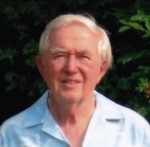
Malcolm Herbert Mac Gregor, a former Lab physicist, died April 19. He was 92.
Mac Gregor was born on April 24, 1926, in Detroit, Michigan, as the oldest of three sons born to Herbert Mac Gregor and Mary Horvath. He served in the U.S. Navy during World War II, and then enrolled at the University of Michigan in 1946, where he graduated in 1953 with a bachelor of arts in mathematics, and an master of arts and Ph.D. in physics. During those years he met his wife, Eleanor, and married her in 1943.
In 1953 the family moved to Walnut Creek before settling in Livermore, where he joined Lawrence Livermore Laboratory and became the first physicist to run experiments on the Laboratory’s variable energy cyclotron. From 1960-61 he held a North Atlantic Treaty Organization fellowship at the Neils Bohr Institute in Copenhagen, while at other times teaching several physics courses and becoming a thesis adviser at University of California, Berkeley.
In 1966 he was accepted as a fellow of the American Physical Society. Between the years 1970–72, he delivered invited colloquia on particle physics at more than 20 universities in the United States and Canada. His publications include more than 100 referred papers in experimental and theoretical physics, and sole authorship of numerous books, including “The Nature of the Elementary Particle” (Springer 1978), “The Enigmatic Electron” (Kluwer 1992 and Springer 2013, followed by a self-published second edition in 2017), and “The Power of Alpha” (World Scientific 2007, which was featured by the Scientific American Book Club). He retired from the Laboratory in 1995, and within a few years moved with Eleanor to Santa Cruz, where he continued working diligently on his final book, “The Alpha Sequence,” which is being reviewed for publication.
The Enigmatic Electron: A Doorway to Particle Masses
El Mac Books, 2013 – Science – 278 pages
This book offers a new look at the electron. It was the first elementary particle discovered, is probably one of the simplest, and yet is possibly one of the most misunderstood. The author presents here a straightforward classical model that accurately reproduces the main spectroscopic features of the electron, and also its principal quantum aspects.
The key to this model is the relativistically spinning sphere, RSS, which has been clamoring for recognition for decades. Although its electrical charge is point-like, the electron itself is Compton-sized, and is composed mainly of non-electromagnetic “mechanical” matter.
The bridge between the electron and the other elementary particles is provided by the fine structure constant alpha 1/137, as manifested in the factor-of-137 spacings between the classical electron radius, electron Compton radius, and Bohr orbit radius.
An expanded form of the constant alpha leads to equations that define the transformation of electromagnetic energy into electron mass/energy, and, via the electron doorway, to the formation of higher-mass lepton and hadron ground states. An alpha-quantized mass-generation grid extends accurately from the electron all the way to the top quark t, and leads to a corresponding alpha-quantized particle lifetime grid.
The mathematics used in these studies is standard, and the calculations are guided by fits to the experimental elementary particle data. This book is written for all scientists who are interested in recent developments in fundamental particle physics.
 Mobius Shaped Electrons