Particle Spins are Chiral
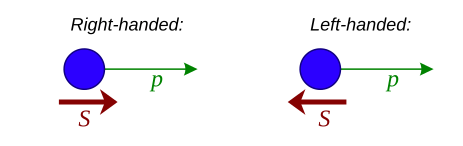
In physics, chirality may be found in the spin of a particle, where the handedness of the object is determined by the direction in which the particle spins.[4]
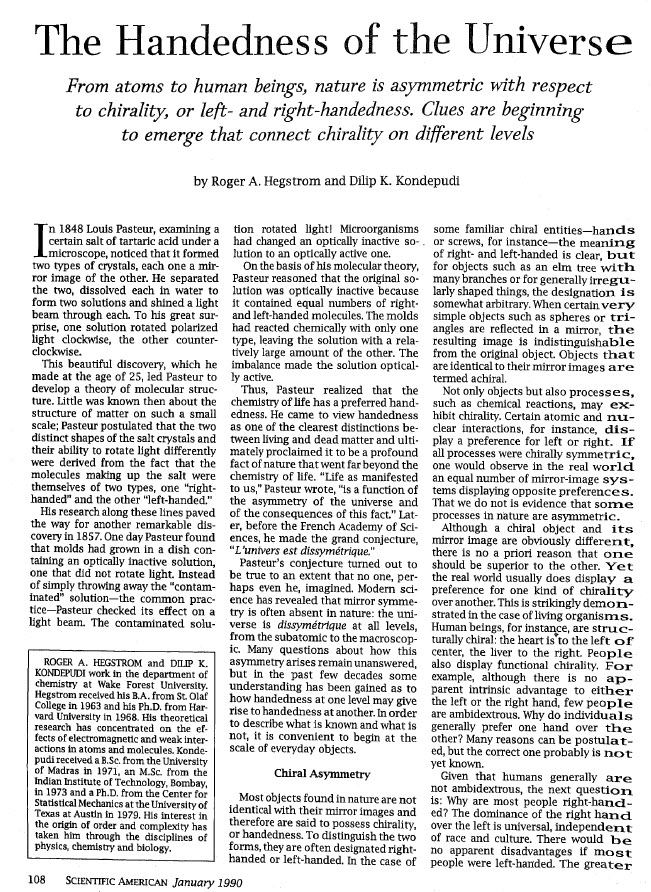
Hegstrom Paper – The Handedness of the Universe
https://mobiuselectrons.com/wp-content/uploads/2025/03/hegstrom_the_handedness_of_the_universe.pdf
Electromagnetism is Chiral
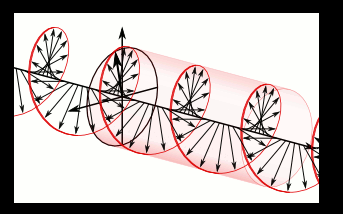
Electromagnetic waves can have handedness associated with their polarization. Polarization of an electromagnetic wave is the property that describes the orientation, i.e., the time-varying direction and amplitude, of the electric field vector. For example, the electric field vectors of left-handed or right-handed circularly polarized waves form helices of opposite handedness in space.
Circularly polarized waves of opposite handedness propagate through chiral media at different speeds (circular birefringence) and with different losses (circular dichroism). Both phenomena are jointly known as optical activity. Circular birefringence causes rotation of the polarization state of electromagnetic waves in chiral media and can cause a negative index of refraction for waves of one handedness when the effect is sufficiently large.[6][7]
Biology has thousands of Chiral Plants and Chiral Chemicals
All of the known life-forms show specific chiral properties in chemical structures as well as macroscopic anatomy, development and behavior.[26] In any specific organism or evolutionarily related set thereof, individual compounds, organs, or behavior are found in the same single enantiomorphic form. Deviation (having the opposite form) could be found in a small number of chemical compounds, or certain organ or behavior but that variation strictly depends upon the genetic make up of the organism. From chemical level (molecular scale), biological systems show extreme stereospecificity in synthesis, uptake, sensing, metabolic processing. A living system usually deals with two enantiomers of the same compound in drastically different ways
In biology, homochirality is a common property of amino acids and carbohydrates. The chiral protein-making amino acids, which are translated through the ribosome from genetic coding, occur in the L form.
Chirality and Helicity (physics)
The helicity of a particle is positive (“right-handed”) if the direction of its spin is the same as the direction of its motion. It is negative (“left-handed”) if the directions of spin and motion are opposite. So a standard clock, with its spin vector defined by the rotation of its hands, has left-handed helicity if tossed with its face directed forwards.
Mathematically, helicity is the sign of the projection of the spin vector onto the momentum vector: “left” is negative, “right” is positive.
The chirality of a particle is more abstract: It is determined by whether the particle transforms in a right- or left-handed representation of the Poincaré group.[a]
For massless particles – photons, gluons, and (hypothetical) gravitons – chirality is the same as helicity; a given massless particle appears to spin in the same direction along its axis of motion regardless of point of view of the observer.
For massive particles – such as electrons, quarks, and neutrinos – chirality and helicity must be distinguished: In the case of these particles, it is possible for an observer to change to a reference frame moving faster than the spinning particle, in which case the particle will then appear to move backwards, and its helicity (which may be thought of as “apparent chirality”) will be reversed. That is, helicity is a constant of motion, but it is not Lorentz invariant. Chirality is Lorentz invariant, but is not a constant of motion: a massive left-handed spinor, when propagating, will evolve into a right handed spinor over time, and vice versa.
A massless particle moves with the speed of light, so no real observer (who must always travel at less than the speed of light) can be in any reference frame where the particle appears to reverse its relative direction of spin, meaning that all real observers see the same helicity. Because of this, the direction of spin of massless particles is not affected by a change of inertial reference frame (a Lorentz boost) in the direction of motion of the particle, and the sign of the projection (helicity) is fixed for all reference frames: The helicity of massless particles is a relativistic invariant (a quantity whose value is the same in all inertial reference frames) which always matches the massless particle’s chirality.
Solar Systems are Chiral (2025, BV Crist)
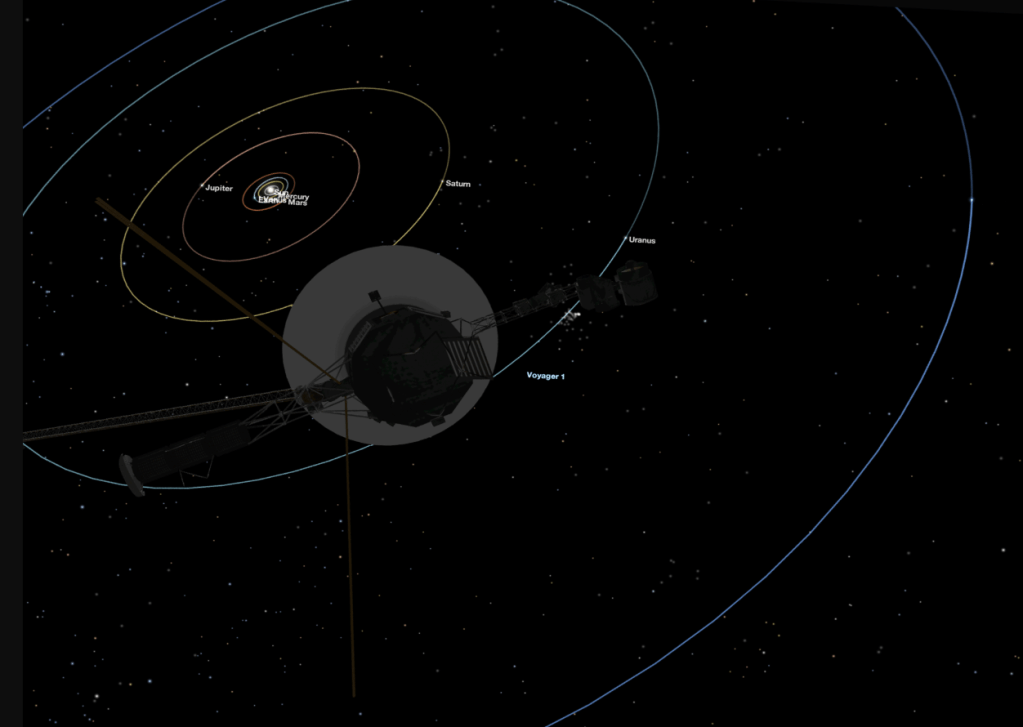
Is our Solar System Chiral? Based on rules for Chirality, yes, our solar system is chiral with its spin being counterclockwise with respect the sun’s north pole.
The planets orbit the Sun in a counterclockwise direction as viewed from above the Sun’s north pole, and the planets’ orbits all are aligned to what astronomers call the ecliptic plane.
The movement of the Earth around the Sun in a fixed path is called a revolution. The Earth revolves from west to east, i.e., in the anticlockwise direction.
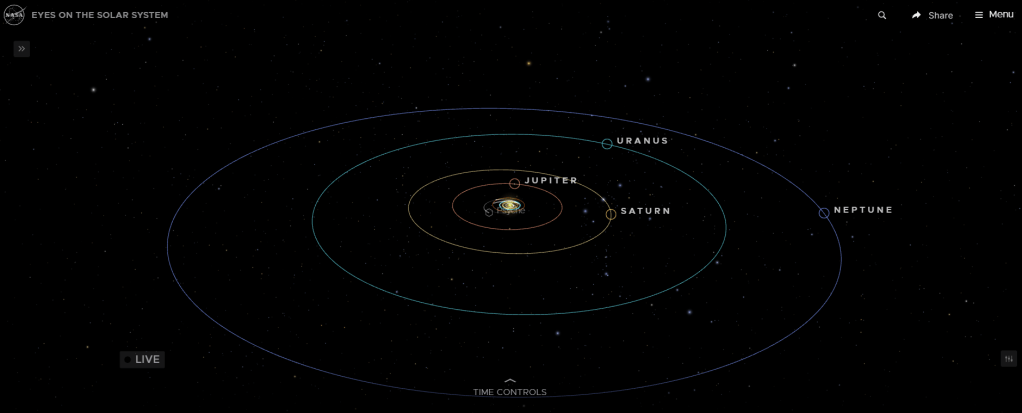



The Moon orbits the Earth in a counterclockwise direction when viewed from above the Earth’s North Pole. The moon’s orbital path around the Earth is in the same direction as the Earth’s rotation, which is counterclockwise when viewed from above the North Pole.
The moon doesn’t appear to rotate because it rotates at the same rate as it orbits the Earth, a phenomenon called synchronous rotation or tidal locking, meaning we always see the same side.
The movement of the Earth around the Sun in a fixed path is called a revolution. The Earth revolves from west to east, i.e., in the anticlockwise direction.
Earth and most of the other planets — including Mercury, Mars, Jupiter, Saturn and Neptune — also spin counterclockwise, but there are some exceptions.
Only Venus and Uranus have this “backwards” rotation.
Kepler’s First Law: each planet’s orbit about the Sun is an ellipse. The Sun’s center is always located at one focus of the orbital ellipse. The Sun is at one focus. The planet follows the ellipse in its orbit, meaning that the planet to Sun distance is constantly changing as the planet goes around its orbit.
Kepler’s Second Law: the imaginary line joining a planet and the Sun sweeps equal areas of space during equal time intervals as the planet orbits. Basically, that planets do not move with constant speed along their orbits. Rather, their speed varies so that the line joining the centers of the Sun and the planet sweeps out equal parts of an area in equal times. The point of nearest approach of the planet to the Sun is termed perihelion. The point of greatest separation is aphelion, hence by Kepler’s Second Law, a planet is moving fastest when it is at perihelion and slowest at aphelion.
Kepler’s Third Law: the squares of the orbital periods of the planets are directly proportional to the cubes of the semi-major axes of their orbits. Kepler’s Third Law implies that the period for a planet to orbit the Sun increases rapidly with the radius of its orbit. Thus we find that Mercury, the innermost planet, takes only 88 days to orbit the Sun. The earth takes 365 days, while Saturn requires 10,759 days to do the same. Though Kepler hadn’t known about gravitation when he came up with his three laws, they were instrumental in Isaac Newton deriving his theory of universal gravitation, which explains the unknown force behind Kepler’s Third Law. Kepler and his theories were crucial in the better understanding of our solar system dynamics and as a springboard to newer theories that more accurately approximate our planetary orbits.
Galaxies – Spiral Galaxies are Chiral
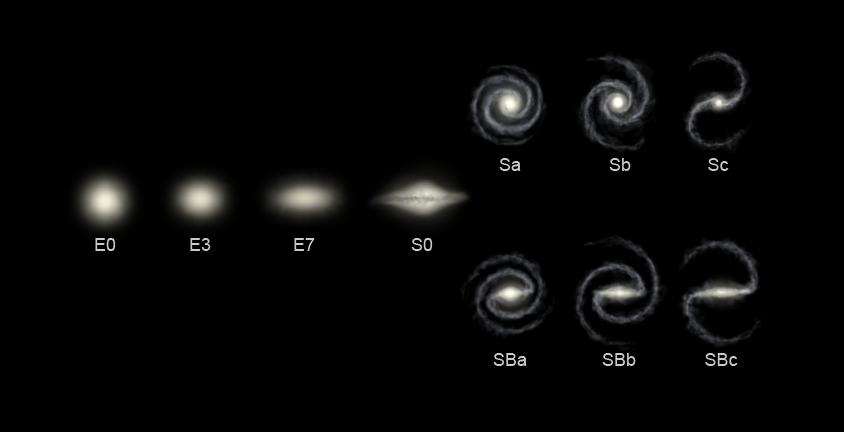

Spiral Galaxies as Chiral Objects – YES
Show affiliations
Abstract
Spiral galaxies show axial symmetry and an intrinsic 2D-chirality. Environmental effects can influence the chirality of originally isolated stellar systems and a progressive loss of chirality can be recognized in the Hubble sequence. We point out a preferential modality for genetic galaxies as in microscopic systems like aminoacids, sugars or neutrinos. This feature could be the remnant of a primordial symmetry breaking characterizing systems at all scales.
Publication:
Astrophysics and Space Science, Volume 301, Issue 1-4, pp. 189-193 Pub Date: January 2006
 Mobius Shaped Electrons