
Scientific studies of the electron began at the beginning of the 18th century along with study of the atom and its particles.
This website is dedicated to revealing a new shape for the electron that the author has been developing over the last 20 years. I reveal its’ shape and structure along with new models for chiral atomic orbitals that do not require an electron to tunnel (as a wave) through the nucleus to populate the opposing empty orbital.
My interest in electrons began in 1983 when I joined a contract service lab that sold XPS analysis services to companies in the Silicon Valley. XPS is a surface chemical analysis technique that measures the kinetic energy and number of “photo-electrons” emitted from the top 50-60 atoms of a solid surface, residing in UHV, when irradiated with Aluminum K-alpha X-rays (1486 eV).
Photo-electrons are electrons that fly freely through the UHV of the XPS instrument until the free Photo-electrons strike a multi-channel plate that is roughly 100 cm away from the surface of the sample. Those electrons have KEs ranging from 0-1487 eV and fly at roughly 10(^5) meters per second which is slower than the speed of light. The actual energies of those electrons when measured by using high energy resolution reveal the chemical states of an element if that element is present in the top 5-6 nm of the surface.
“Classical” Electron (Wikipedia copyleft rights)
Sir JJ Thomson
Sir Joseph John Thomson (18 December 1856 – 30 August 1940) was an English physicist who received the Nobel Prize in Physics in 1906 “in recognition of the great merits of his theoretical and experimental investigations on the conduction of electricity by gases.”[1]
In 1897, Thomson showed that cathode rays were composed of previously unknown negatively charged particles (now called electrons), which he calculated must have bodies much smaller than atoms and a very large charge-to-mass ratio.[2]
Description of the Electron (Wikipedia copyleft rights)
The electron (e−, or β− in nuclear reactions) is a subatomic particle with a negative one elementary electric charge.[13] Electrons belong to the first generation of the lepton particle family,[14] and are generally thought to be elementary particles because they have no known components or substructure.[1] The electron’s mass is approximately 1/1836 that of the proton.[15] Quantum mechanical properties of the electron include an intrinsic angular momentum (spin) of a half-integer value, expressed in units of the reduced Planck constant, ħ.
Being fermions, no two electrons can occupy the same quantum state, per the Pauli exclusion principle.[14] Like all elementary particles, electrons exhibit properties of both particles and waves: They can collide with other particles and can be diffracted like light. The wave properties of electrons are easier to observe with experiments than those of other particles like neutrons and protons because electrons have a lower mass and hence a longer de Broglie wavelength for a given energy.
Electrons play an essential role in numerous physical phenomena, such as electricity, magnetism, chemistry, and thermal conductivity; they also participate in gravitational, electromagnetic, and weak interactions.[16] Since an electron has charge, it has a surrounding electric field; if that electron is moving relative to an observer, the observer will observe it to generate a magnetic field.
Electromagnetic fields produced from other sources will affect the motion of an electron according to the Lorentz force law. Electrons radiate or absorb energy in the form of photons when they are accelerated.
In 1838, British natural philosopher Richard Laming first hypothesized the concept of an indivisible quantity of electric charge to explain the chemical properties of atoms.[3] Irish physicist George Johnstone Stoney named this charge “electron” in 1891, and J. J. Thomson and his team of British physicists identified it as a particle in 1897 during the cathode-ray tube experiment.[5]
Discovery of the Electron (Wikipedia copyleft rights)
Several scientists, such as William Prout and Norman Lockyer, had suggested that atoms were built up from a more fundamental unit, but they envisioned this unit to be the size of the smallest atom, hydrogen.
Thomson in 1897 was the first to suggest that one of the fundamental units of the atom was more than 1,000 times smaller than an atom, suggesting the subatomic particle now known as the electron. Thomson discovered this through his explorations on the properties of cathode rays.
Thomson made his suggestion on 30 April 1897 following his discovery that cathode rays (at the time known as Lenard rays) could travel much further through air than expected for an atom-sized particle.[30] He estimated the mass of cathode rays by measuring the heat generated when the rays hit a thermal junction and comparing this with the magnetic deflection of the rays.
His experiments suggested not only that cathode rays were over 1,000 times lighter than the hydrogen atom, but also that their mass was the same in whichever type of atom they came from. He concluded that the rays were composed of very light, negatively charged particles which were a universal building block of atoms. He called the particles “corpuscles”, but later scientists preferred the name electron which had been suggested by George Johnstone Stoney in 1891, prior to Thomson’s actual discovery.[31]
In April 1897, Thomson had only early indications that the cathode rays could be deflected electrically (previous investigators such as Heinrich Hertz had thought they could not be). A month after Thomson’s announcement of the corpuscle, he found that he could reliably deflect the rays by an electric field if he evacuated the discharge tube to a very low pressure.
By comparing the deflection of a beam of cathode rays by electric and magnetic fields he obtained more robust measurements of the mass-to-charge ratio that confirmed his previous estimates.[32] This became the classic means of measuring the charge-to-mass ratio of the electron. Later in 1899 he measured the charge of the electron to be of 6.8×10⁻¹⁰ esu.[33]
Thomson believed that the corpuscles emerged from the atoms of the trace gas inside his cathode-ray tubes. He thus concluded that atoms were divisible, and that the corpuscles were their building blocks. In 1904, Thomson suggested a model of the atom, hypothesizing that it was a sphere of positive matter within which electrostatic forces determined the positioning of the corpuscles.[2]
To explain the overall neutral charge of the atom, he proposed that the corpuscles were distributed in a uniform sea of positive charge. In this “plum pudding model“, the electrons were seen as embedded in the positive charge like raisins in a plum pudding (although in Thomson’s model they were not stationary, but orbiting rapidly).[34][35]
Thomson made the discovery around the same time that Walter Kaufmann and Emil Wiechert discovered the correct mass to charge ratio of these cathode rays (electrons).[36]
The name “electron” was adopted for these particles by the scientific community, mainly due to the advocation by George Francis FitzGerald, Joseph Larmor, and Hendrik Lorentz.[37]: 273
The term was originally coined by George Johnstone Stoney in 1891 as a tentative name for the basic unit of electrical charge (which had then yet to be discovered).[38][39] For some years Thomson resisted using the word “electron” because he didn’t like how some physicists talked of a “positive electron” that was supposed to be the elementary unit of positive charge just as the “negative electron” is the elementary unit of negative charge.
Thomson preferred to stick with the word “corpuscle” which he strictly defined as negatively charged.[40] He relented by 1914, using the word “electron” in his book The Atomic Theory.[41] In 1920, Rutherford and his fellows agreed to call the nucleus of the hydrogen ion “proton”, establishing a distinct name for the smallest known positively-charged particle of matter (that can exist independently anyway).[42]
Arthur Compton paper on Electron in 1919
Copyrights belong to APS
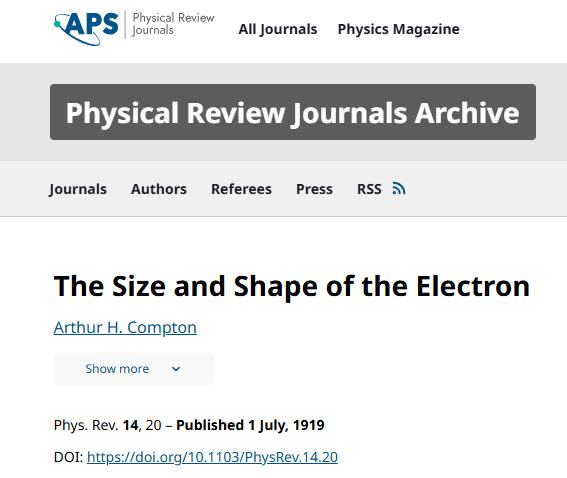
Abstract
Synopsis.—Attention is called to two outstanding differences between experiment and the theory of scattering of high frequency radiation based upon the hypothesis of a sensibly point charge electron. In the first place, according to this theory the mass scattering coefficient should never fall below about.2, whereas the observed scattering coefficient for very hard X-rays and 𝛾-rays falls as low as one fourth of this value.
In the second place, if the electron is small compared with the wave-length of the incident rays, when a beam of 𝛾-rays is passed through a thin plate of matter the intensity of the scattered rays on the two sides of the plate should be the same, whereas it is well known that the scattered radiation on the emergent side of the plate is more intense than that on the incident side.
It is pointed out that the hypothesis that the electron has a diameter comparable with the wave-length of the hard 𝛾-rays will account qualitatively for these differences, in virtue of the phase difference between rays scattered by different parts of the electron.
The scattering coefficient for different wave-lengths is calculated on the basis of three types of electron: (1) A rigid spherical shell of electricity, incapable of rotation; (2) a flexible spherical shell of electricity; (3) a thin flexible ring of electricity. All three types are found to account satisfactorily for the meager available data on the magnitude of the scattering coefficient for various wave-lengths.
The rigid spherical electron is incapable of accounting for the difference between the emergent and the incident scattered radiation, while the flexible ring electron accounts more accurately for this difference than does the flexible spherical shell electron.
It is concluded that the diameter of the electron is comparable in magnitude with the wave-length of the shortest 𝛾-rays. Using the best available values for the wave-length and the scattering by matter of hard X-rays and 𝛾-rays, the radius of the electron is estimated as about 2 × 10⁻¹⁰ cm.
Evidence is also found that the radius of the electron is the same in the different elements. In order to explain the fact that the incident scattered radiation is less intense than the emergent radiation, the electron must be subject to rotations as well as translations.
 Mobius Shaped Electrons